Lesson Plan Outline:
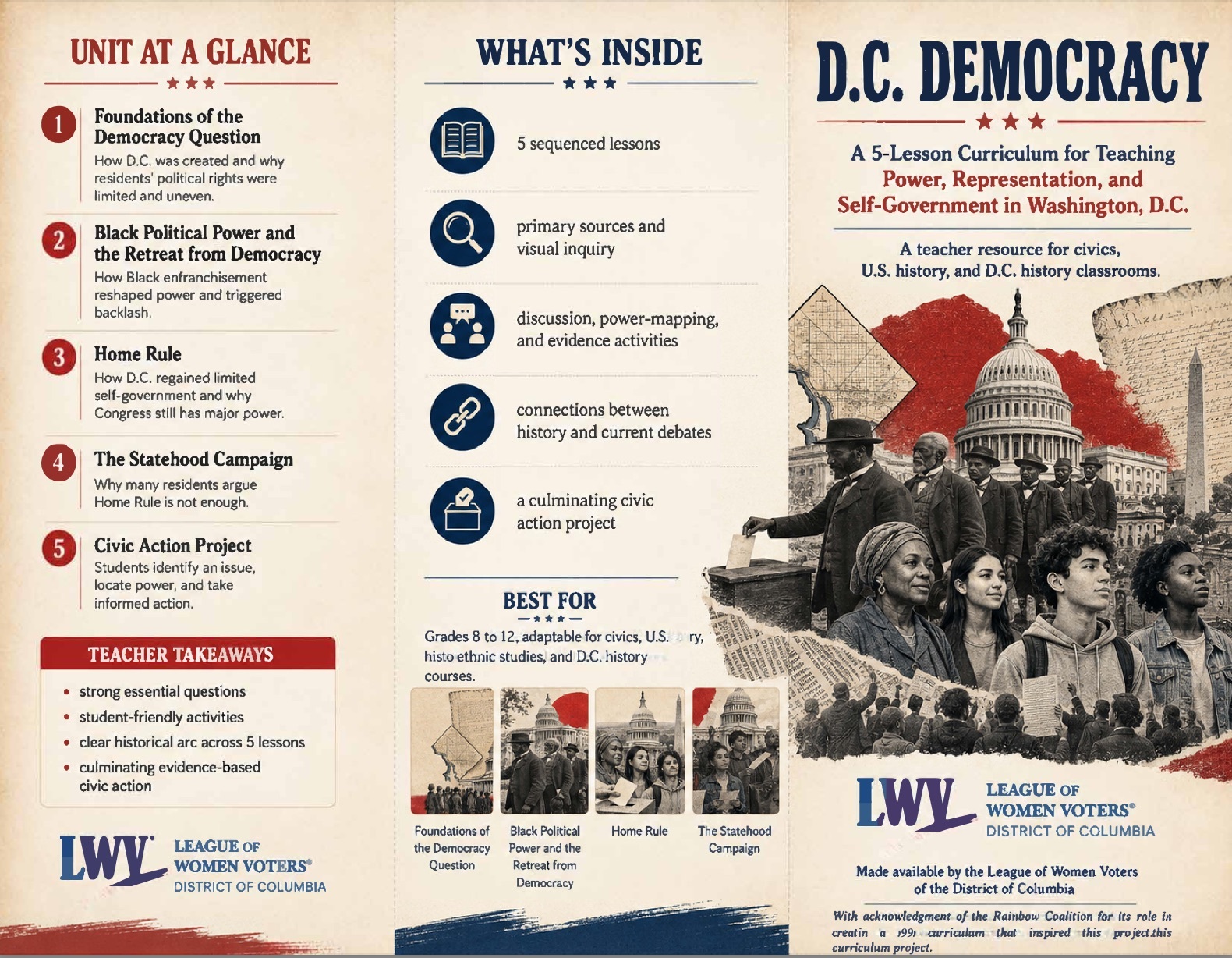
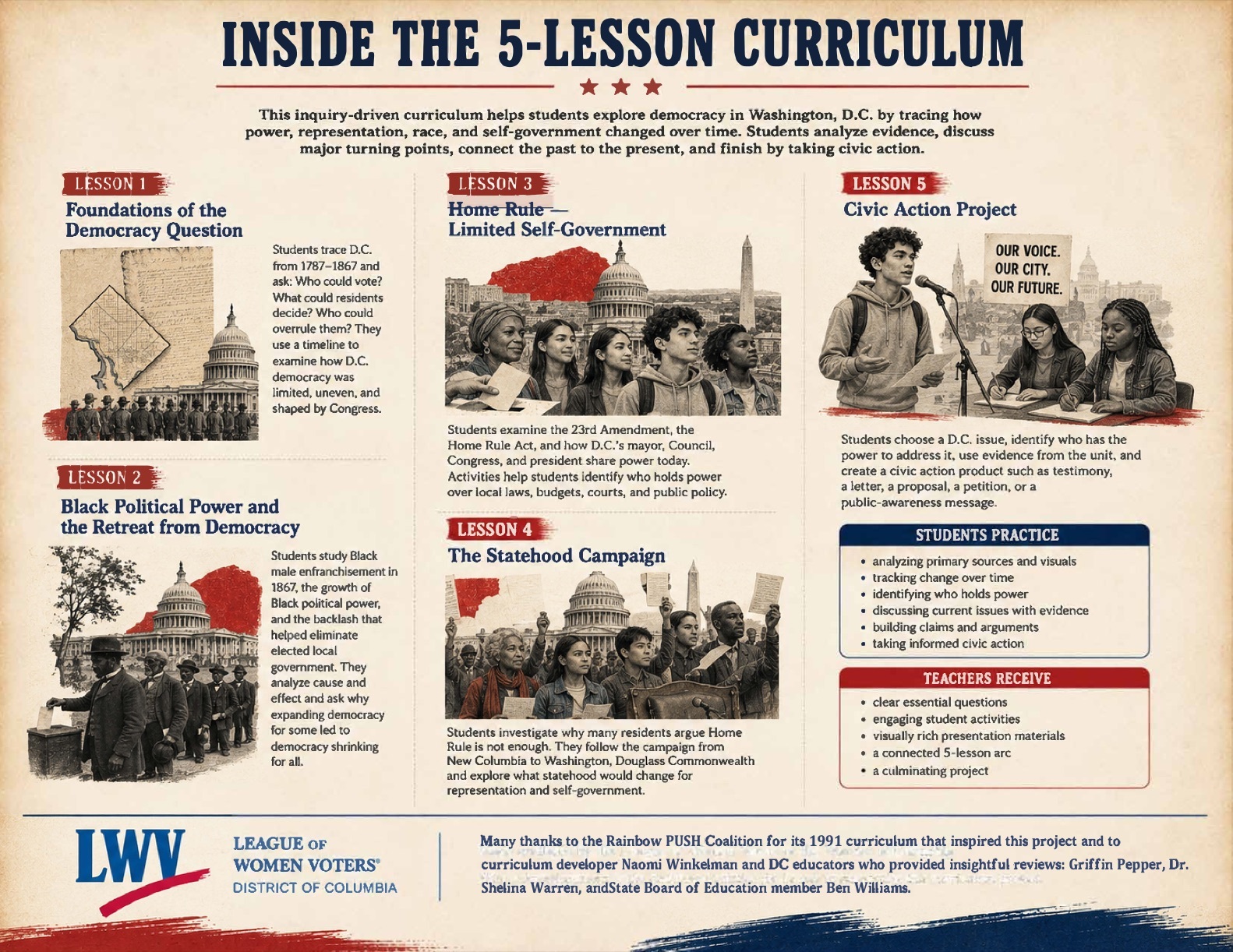
Download the overview pamphlet here.
Before getting started on the lessons, download the comprehensive teacher's guide here.
Lesson 1: Foundations of the Democracy Question
A timeline story about who had access to democracy before Reconstruction.
Essential Question: How did the creation of Washington, D.C. change who could vote, who was represented, and who had power over the city before Reconstruction?
- Part 1: A Federal District is Planned
- Part 2: The First Loss of National Political Voice
- Part 3: Freedom Expands, but Democracy is Still Incomplete
Download Lesson 1 here.
Lesson 2: Turning Point: Black Political Power and the Retreat from Democracy
An inquiry into voting rights, racial backlash, and D.C. self-government.
Essential Question: Why was the rise of black political power after the Civil War a major turning point in D.C. democracy?
- Part 1: What Does Democracy Require?
- Part 2: Who Gets to Enter Democracy?
- Part 3: Enfranchisement Becomes Empowerment.
- Part 4: Black Power Produces Backlash.
- Part 5: Democracy Expands — And Then Retreats
- Conclusion: Today
Download Lesson 2 here.
Lesson 3: Home Rule — A Civil-Rights Victory With a Ceiling
How D.C. regained an elected local government — and why Congress still had control.
Essential Question: When residents elect leaders, who still has the final word?
- The Local Ballot Taken Away (1874)
- D.C.'s Struggle in Relation to the Modern Civil Rights Movement
- Congress Passes the Home Rule Act (1973)
- Structure of D.C. Government Today
Download Lesson 3 here.
Lesson 4: The Fight for D.C. Statehood
From political reform to a decades-long struggle for full representation and local self-government.
Essential Question: How did D.C. activists turn partial political victories into a long movement for statehood?
- Part 1: From Home Rule to Statehood
- Part 2: From Demand to Formal Plan
- Part 3: Congress Becomes the Main Battleground
- Part 4: Free D.C. and the Fight Today
Download Lesson 4 here.
Lesson 5: Civic Action Project
A final project based on Lessons 1-4: Foundations, Reconstruction Backlash, Home Rule, and the Statehood Debate.
Essential Question: When a community faces a problem, who has the power to respond — and how can residents use evidence to be heard?
- Step 1: Choose a Civic Issue
- Step 2: Connect Your Issue to the Unit
- Step 3: Research the Issue
- Step 4: Build a "Who has Power?" Map
- Step 5: Choose One Civic Action
Download Lesson 5 here.